LECTURE REFLECTION
I find the research into the design process to be very interesting. It really got me thinking about the way in which I myself come up with ideas & develop them. Last week’s topic, which was about “the self” had also gotten me thinking about this very matter, & in fact it has only been a couple months of me really looking into who I am as a designer, how I get ideas & how I put them into my projects.
“Design is defined by employing a combination of the intuitive & the cognitive” – Bruce Archer
As mentioned in the lecture, there are so many factors that can be taken in count nowadays when it comes to designing, that it is very easy to get overwhelmed & lost in the middle of it all. @ the same time, I find this to be very useful: having unlimited resources & ideas to go to can be a great source of inspiration, but then again one needs to know when to stop to not go too far or develop something further than it should have been to stay coherent.
The double diamond approach, with the stages of discovery, defining, development & delivery, is a very thought out & interesting way of approaching a project. I have never really set myself any rules or boundaries to follow, but have most likely used aspects of this approach unconsciously before.
Iain McGilchrist’s “Divided Brain” animated video highlighted that theoretically society was built over the years on a very left side of the brain basis (logical, fixed, comprehensive), yet we try to live by a right side of the brain basis (individuality, change, evolution). I found this to be very interesting, & in fact, very representative of how it really is. It opened my eyes even more to the flawed system we are raised into, & definitely fed my rebellious views. Overall, I believe that the way we generate ideas is all based on more than just how our brain is structured, & it also influenced by genetical & environmental factors, as well as a mix of how far we as individuals are willing to look into developing our interest in the matter.
How Do I Generate Ideas?
It has come to my attention that I have never really had a set process when it comes to generating my ideas. In fact, I am horrible @ working by following a set of rules: I cannot work on a schedule, work from a to do list, & really struggle with following steps. All of these factors make it really hard for me to find a way of thinking or a process I can relate to or even just comprehend.
Generally, I’ve found that when creating an artwork for a client, I tend to have sparks of ideas once I am given a short brief on what emotions the client wants the artwork to convey, as well as the tone, the colour scheme, shapes etc. I always ask to listen to the track or album I’m making the artwork for, so that I can sit down, put it on & just write down what the track makes me feel, as well as picking out general themes found in the lyrical content. Then, I do some research online to find inspiration from works people have created, put together some mood boards, & then from that, draw elements I really like or believe fits the vision of the artist. Then I do some sketches in Photoshop, layer some images, try out some random effect I think might look cool, & then usually print out the result to work on it with pen & paper. Then whatever I come up with I usually re-digitalise & then I modify it & clean it all up. So pretty standard stuff I’d say, nothing too over the top. Of course, the process can differ: each project & each client is different.
RESEARCH & REFLECTION
The Drake Equation
Having the opportunity to research into science related ways of thinking got me super excited. The idea to look into this got sparked when Matt mentioned he was going to do something relating to the theory of the flat earth & people’s thought process into to believing it. Many ideas crossed my mind (the development of constellations, blackhole theory, the understanding of gravity), & the main one that resonated with me what Drake’s Equation. It’s purpose, it so estimate the number of intelligent alien civilisations around the universe, showing that it is in fact statistically impossible that we, the human race, are the only one.

This basically opened my mind to what this weeks brief was actually about, and finally made me understand it. I understood exactly what was asked of me: to visually represent how something is worked out from step A to Z, which is what this equation does.
The Decision Tree of Chess
I came across this tree diagram whilst researching into the Drake Formula. This piece is called “The Decision Tree of Chess.”

I loved the complexity of the content yet the simplicity of the design. The diagram explains the way of thinking of an individual playing chess, & gives us a visual understanding of what moves can be done when, until resulting to an end point, marking the end of the game. This really portrays the complexity & thinking pattern that needs to be thought of when playing chess, & reminds us that it is always important to be thinking 1 move ahead.
Piet Mondrian
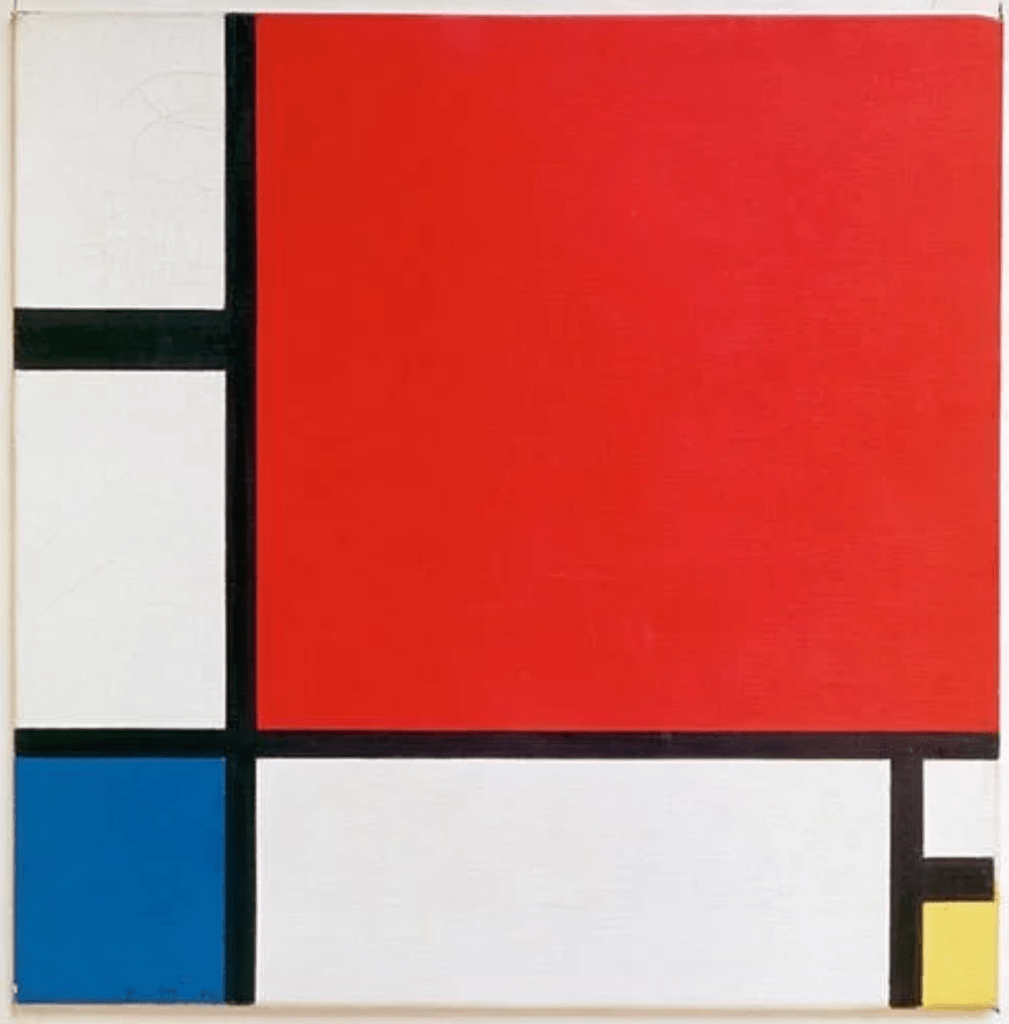
“I wish to approach truth as closely as possible, and therefore I abstract everything until I arrive at the fundamental quality of objects” – Piet Mondrian
To me, nothing screams “simple black line drawing” more than Mondrian’s 1920’s work. He was the founder of the De Stijl movement, & his abstract simplified work was described by him as “the spiritual order underlying the visible world, creating a clear, universal aesthetic language” (The Art Story, 2020). I appreciate the simplicity yet thought out complexity of his work, & it had me wanting to look even deeper into that style of art, but on a more modern level.
Sophie Douala
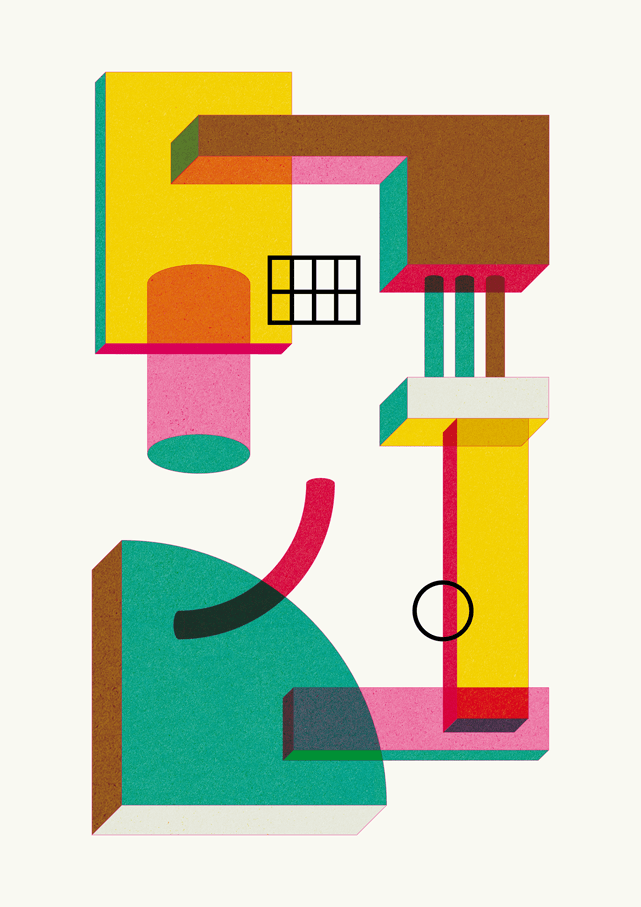
Sophie Douala, a French artist based in Berlin, Germany, works a lot with 3D shapes, lines & colours (Douala, 2014). I absolutely love her style & use of abstract shapes to create a balanced & calculated piece of work. Adding colours definitely enhances the impact the design has on the audience, & I want to try & incorporate this into my outcome.
WORKSHOP CHALLENGE
All the previous research had me thinking about how I could make some sort of shark migration chart explaining their reasoning behind migrating to specific area. Unfortunately, the research on this matter is very limited, & poses more questions than answers, yet I wanted to stick with the shark idea, as I believe it is a unique topic when it comes to their thought process, & what better way to do this than to look into their hunting habits?
Shark Side of the Moon

I wanted to portray a great white sharks’ thought process on hunting seals. For this, I researched into a study conducted by Neil Hammerschlag, Chris Fallows & Monique Fallows (Fallows, 2017).
Their aim was to find out if there would be a difference in shark attack rate & capture success during a full moon VS a new moon @ sunrise. They collected data over 16 years, & analysed the attack VS success rates of 1,476 shark attacks on seals during new moons (low lunar illumination) and full moons (high lunar illumination).
Great whites hunting during the night on a full moon have a higher advantage as they can see the silhouettes of the seals more efficiently, meaning that when the sun starts to rise, the added light makes it easier for the seals to detect the sharks. Therefore, they found that attacks & success rates during new moons at sunrise were about double than during full moons @ sunrise, yet attacks during the night of a full moon were more successful overall but there were less of them.
So why do the sharks attack less during a full moon (prior to sunrise), if it is @ a visual advantage & is more likely to be successful? This is a question we might never find the answer to, though the researchers hypothesised it could be because the shark was already satisfied with the prior night’s hunt (as full moons only occur every couple weeks, the shark could have successfully hunted when it was hungry days before).
Further reflection on the study
I think when it comes to the shark hunting, it unconsciously takes in count 2 main factors: 1) Am I hungry?, & 2) Is there an opportunity to attack a nearby seal? If the shark is hungry, it is more likely to actively look for a prey & attempt an attack, while if it less hungry, it might think it can wait a couple days for better visibility instead of tiring itself out & be deceived. Therefore I do not believe the moon intends to have an impact on the sharks’ hunting behaviour, but I believe instead that after trial & error, a shark has become aware of their successes & failures, & now know when the best visibility to attack is.
I wanted my first sketches to illustrate the great white shark’s thinking pattern when it comes to hunting seals; or not, so basically: their process (of course, this is all just my interpretation, as there is no way to 100% know what goes through in their mind).
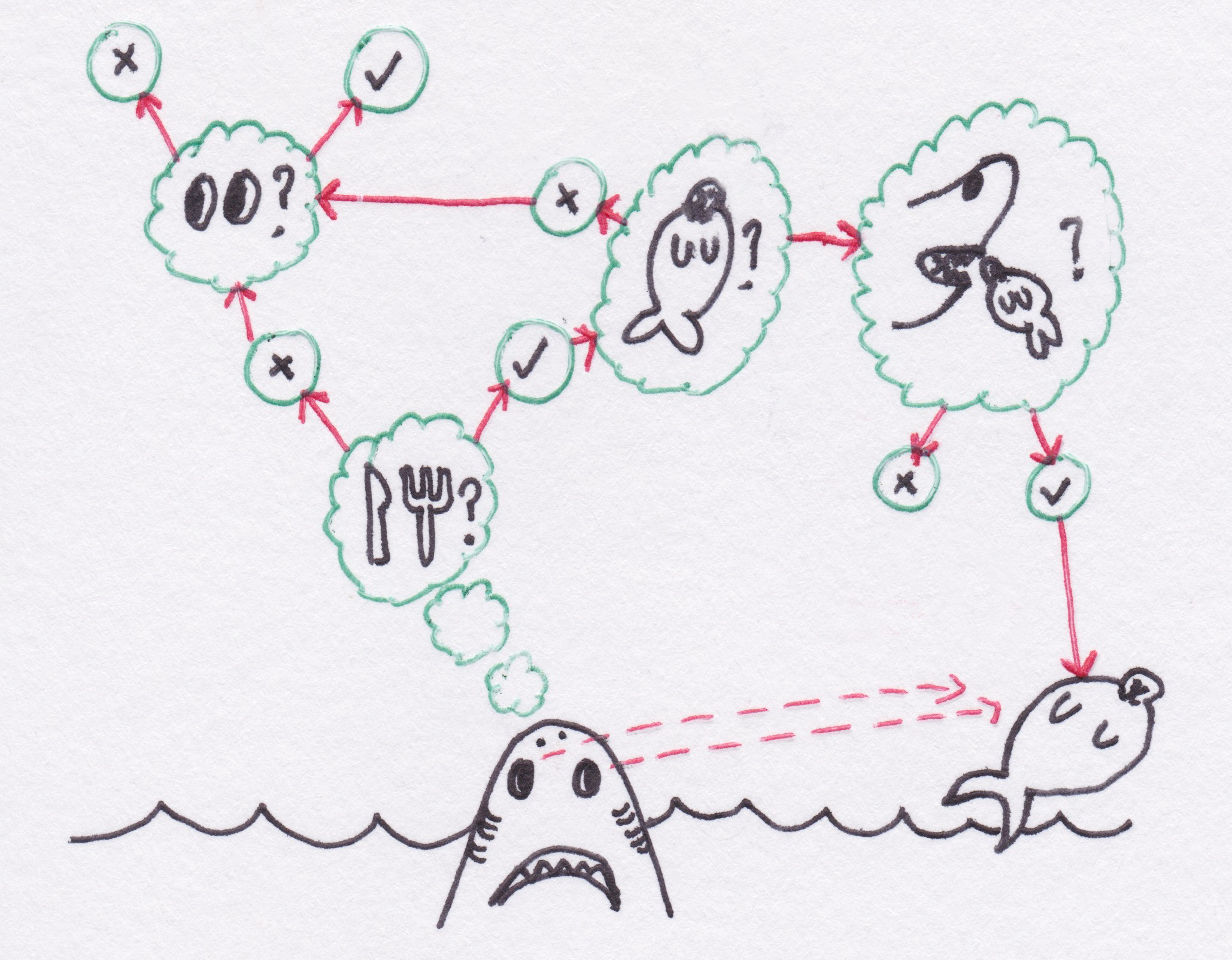
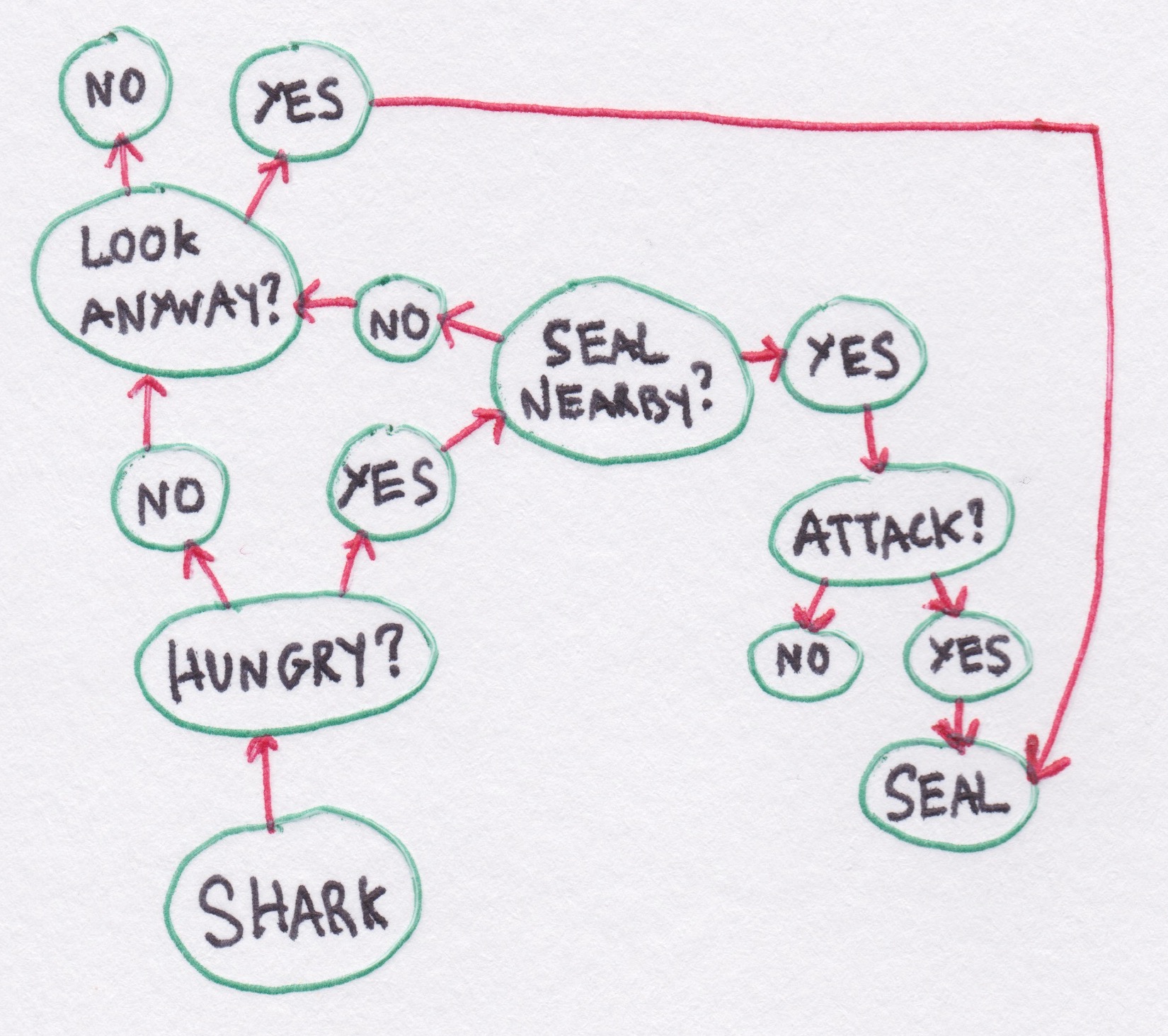
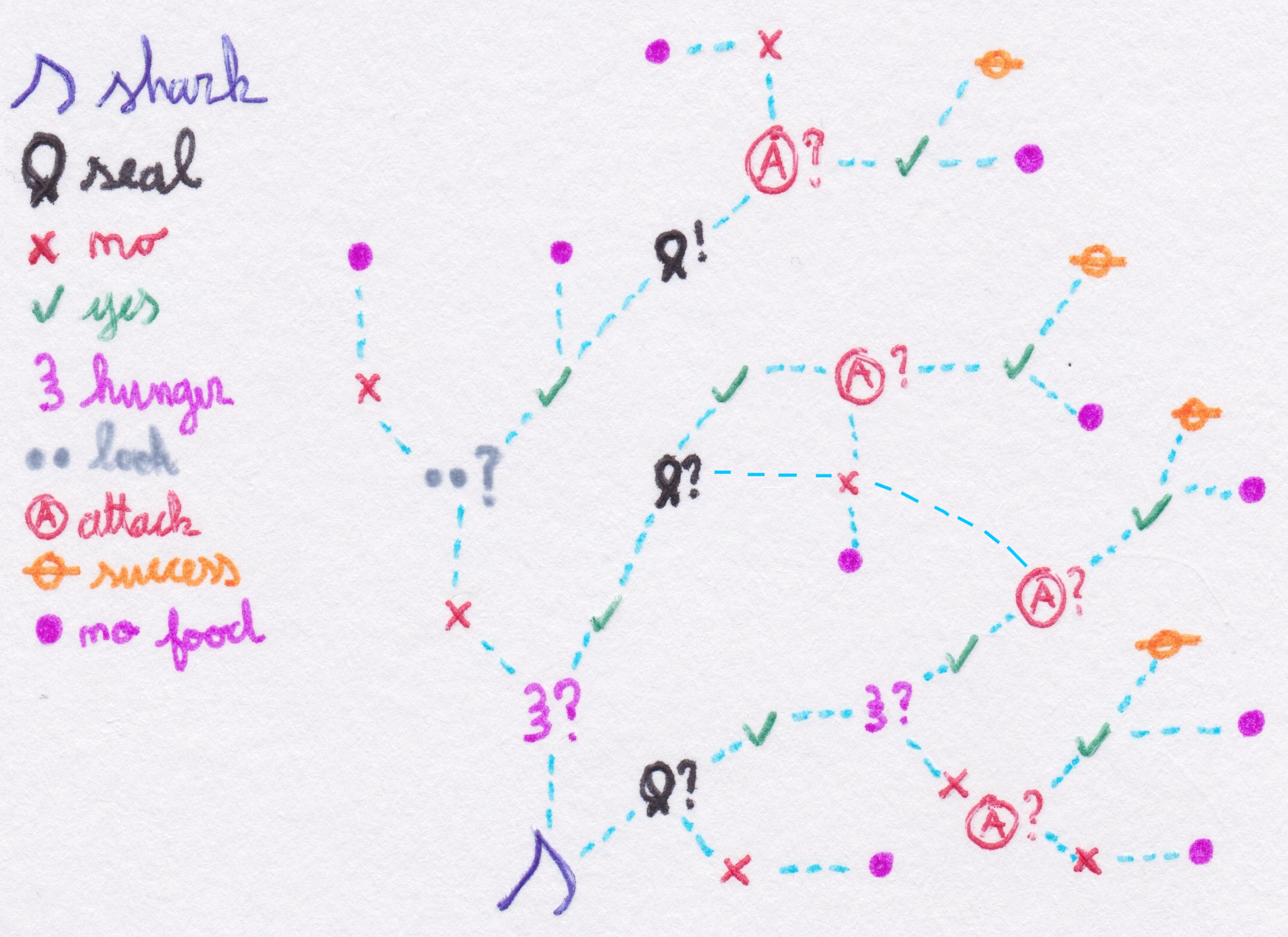
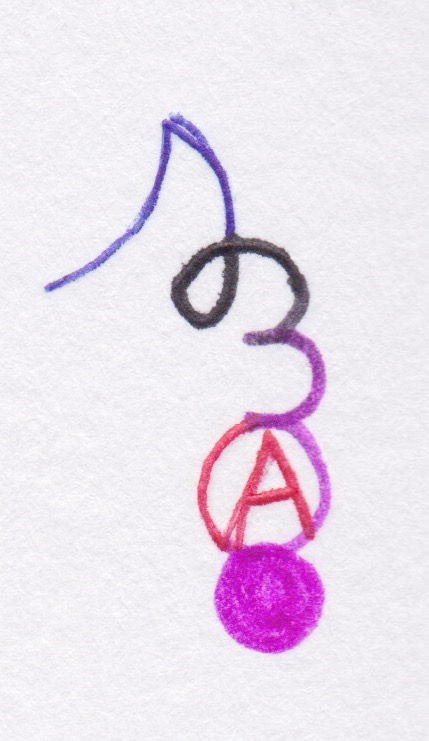
Here are the 4 stages of my sketches. The 1st one shows a simple sequence in pictures, which is then explained by the 2nd picture in words. For the 3rd one, I wanted to make the whole sequence more detailed & simple, so I decided to code each stage, & make sure each of my endings on sequence would end with either the shark being successful with an attack or without food. I wanted the sequence to start with the shark thinking of the 2 instincts: am I hungry? & is there an opportunity? The 4th sketch is the most simplified I could get to: I selected a sequence from the 3rd design (shark sees seal -> shark is hungry -> shark decides to attack -> attack is unsuccessful) & interlinked each symbol to create a simple yet complicated design. It shows how simple yet complicated the thinking process is, with all its various shapes, & also gives us an insight into how complicated & fascinating animal psychology truly is.
Second thought
I was unhappy with my final design, & wanted to take it further & also present it better. I disliked how my outcome only showed 1 of the 16 possible outcomes I have previously created, & so I decided to include all 16 at once.
My initial idea was to make this interactive & fun. I wanted each option to be open to the randomisation, as it is how it would be with the shark’s thought process, & so I chose to present my outcome like tear off papers examples bellow.

The idea of the 16 outcomes is to clearly portray the thought processes that the shark can go through. It follows the 16 theoretical steps outcomes I have highlighted before (which all start from one of the two instincts: am I hungry? Is there an opportunity to hunt?). I let go of the colours as I believed it made everything too messy, & with the key there now, there is no need to precisely outline each symbol as it is easy to pair them up.
FINAL OUTCOME
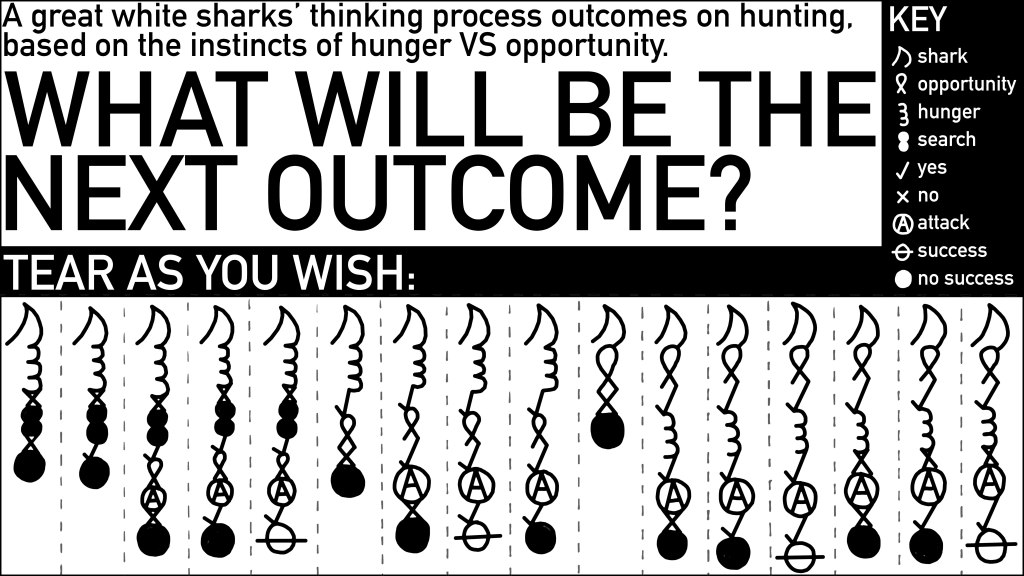
REFLECTION: I’m very satisfied by this piece. The composition is simple & all the explanatory elements are on the slide. Keeping it monochromatic looks more serious & legible, & having a clear key means the views knows what they are looking at. They are given the chance to be in the sharks’ thought process & actions for a few instances. What they tear out, is up to them.
REFERENCES
The Art Story. 2020. Piet Mondrian. [online] Available at: <https://www.theartstory.org/artist/mondrian-piet/> [Accessed 22 March 2020].
Douala, S., 2014. Graphic Design By Sophie Douala. [online] Trendland Online Magazine. Available at: <https://trendland.com/graphic-design-by-sophie-douala/> [Accessed 22 March 2020].
Drake, F., 1961. Drake Equation.
Fallows, C., Fallows, M. and Hammerschlag, N., 2016. Effects of lunar phase on predator-prey interactions between white shark (Carcharodon carcharias) and Cape fur seals (Arctocephalus pusillus pusillus). Environmental Biology of Fishes, 99(11), pp.805-812.
Kamine, S. and Botvinnik, M., 1970. The Decision-Tree Of A Chess Study. New York, p.12.
Mondrian, P., 1930. Composition II In Red, Blue, And Yellow. [oil on canvas].
 Mandy Galli