LECTURE REFLECTION
My definition of the word “research”: to investigate a specific area of research & come up with facts to support a certain point made, or simply to find an answer to a certain question or problem.
I find research to be a very big part of my daily life. Whether it is academic, to find out how to do something, or just to learn a random fact. Today we have access to almost all the questions we want answers to, & not many people will actually seize this opportunity & go out & do their own research on the questions they come up with, which is a shame really.
When writing my dissertation, I had to do a lot of research & dig very deep into a subject that @ the end of the day had very limited information online, even when it came to academic websites provided by my campus.
Many people when they hear the word “research” are thrown back to school & how they were somewhat forced to do research on things that did not interest them in the first place, which is the reason why I believe that today, when mentioning research to someone, they are very likely to look @ you with fear in their eyes.
A look around my room
I have actually had a huge clean around my room just a few days ago. My room is pretty big, & all my stuff is mainly hidden away in the drawers under my bed. I would definitely say it is very cozy, even though I am currently sitting on my floor next to my heater because I was too lazy to switch the location of my outlet… I have a huge window @ the front of my room, which lets a lot of the cold air inside. Nonetheless, it gives my room a lot of light & having the walls painted white, as well as having white bed sheets, reflects the light in the entire room. I think a lot about moving my furniture around, only thing stopping me now is how heavy my bed is with all the stuff in the drawers. But I believe the room is the cosiest it can be with the furniture I have. Moving things around would make the room seem smaller & less spacious. I don’t really tend to have many objects laying around, most are neatly put away in a drawer.
WORKSHOP CHALLENGE
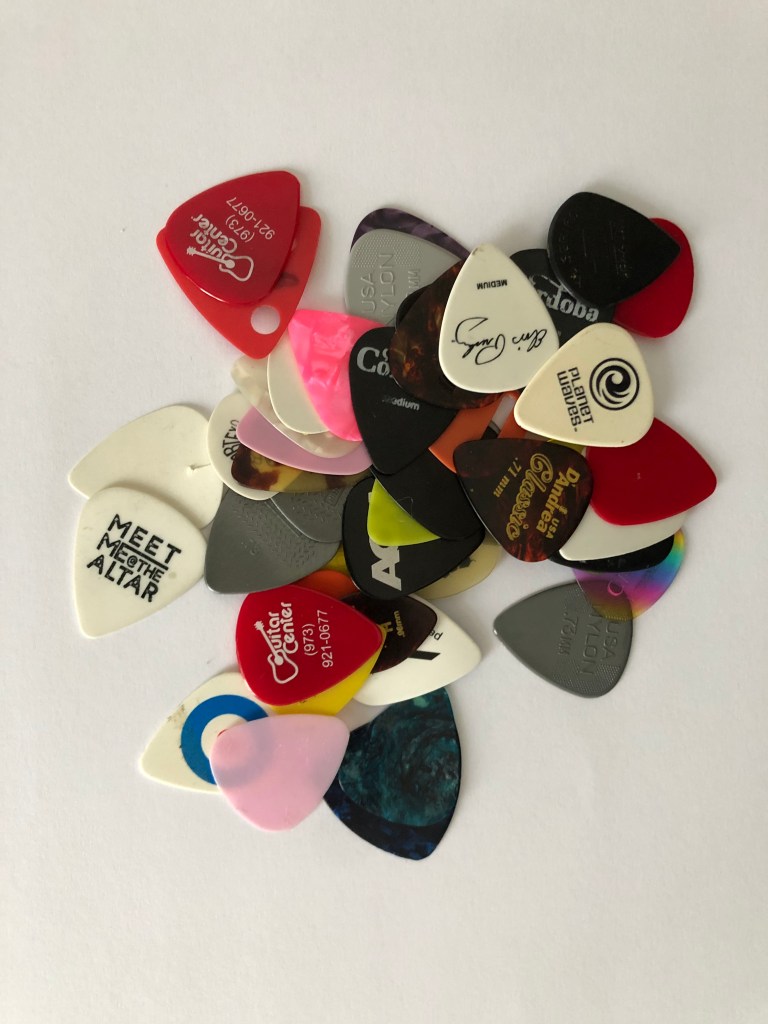
Whilst looking around my room, the one object that really stood out to me was my pokeball, which I have filled with guitar picks. I’ve been collecting picks since I started playing guitar about 7 years ago. I’ve never really thought about picks & where they came from, what they were originally made of, what different shapes mean & different thicknesses change. So I decided to do research on this matter.
I took this picture of some of my picks to include in my final publication:
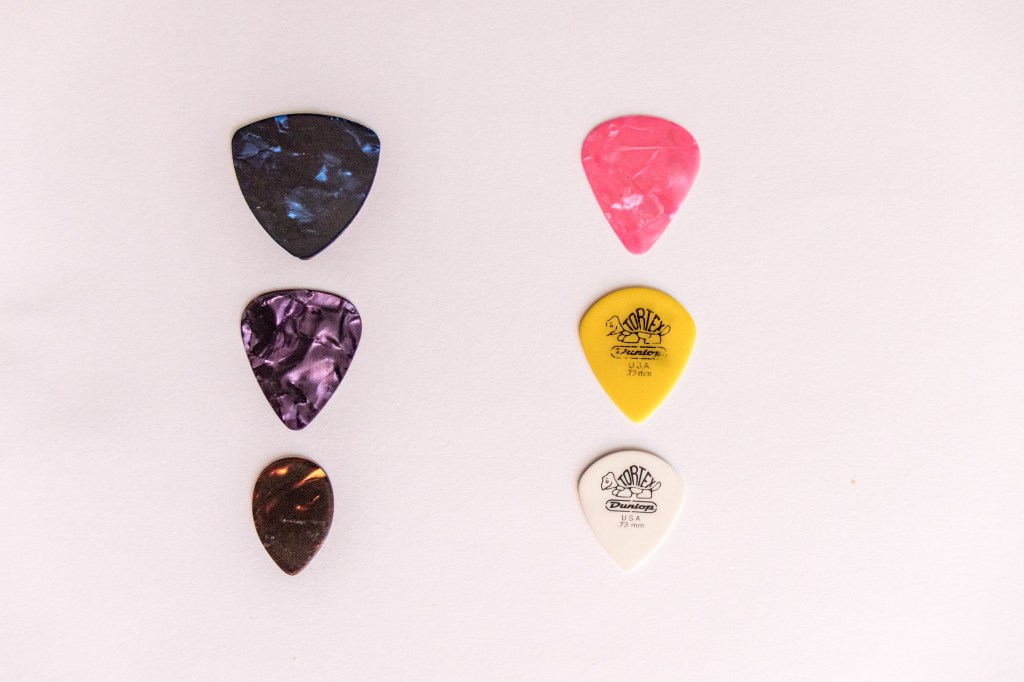
& got this image from shutterstock to use as my mockup:

From Worshipped to Worthless
To structure my 300 word essay I wanted to include the following layout: what picks are/ their usage, discuss how they are taken care of, history on picks & what they are/were made out of, wrap it up with something about picks today.
I did most of my research online, & found out that there actually is not a lot of secondary research on this topic. I did find 1 very interesting book titled “Picks!: The Colorful Saga of Vintage Celluloid Guitar Plectrums!” by Will Hoover, which came to give me most of the research I was looking for.
My text
Title: Worshipped to Worthless
Picks are plectrums, which are small thin pieces of material held between the fingers & thumb to play stringed instruments (Plectrum Definition, 2020). The ideal pick allows the user to maintain a firm grip whilst it helps produce the best sound when strumming, making it a very important tool to the ones who use it. Consequently, I see picks as a very disregarded item, yet very important for prominently a lot of guitar players. Along my years of going to music studios, visiting Guitar Centres’ in the states, & going around friends’ houses, I would often see picks disregarded in a corner, or on the floor with no care or attention. My research, though, shows how rare and priced a pick actually used to be before becoming commercialised. This was mainly due to the original materials used to manufacture them, & how little of them were made. The materials used for picks went from feather quills (771 a.d. – 1400), to ostrich feathers (1700 – 1800), to hawksbill turtle shells & ivory (1800’s) (History of Guitar Picks, 2019). At this point, picks used to be seen as a rare object, which was hard to make, & only the most notable musicians could acquire & use them. With the expensive and limited availability of hawksbill turtle shells & ivory, along with rising ethical concerns & species endangerment building up, pick manufacturers had to find another solution. All the ethical issues ended up causing a huge toll on the sales & reputation of guitars (Hoover, 1995). Celluloid was patented in 1870, & in the 1920’s, the d’Andrea company decided to commercialise picks made of celluloid, which changed to composite plastics in the 1940’s, & saved the views people had on the guitar industry (Menasché, 2017). Nowadays, there are multitudes of materials that are used to create picks, such as nylon, glass, wood, steel & bone. This makes it a very easily commercial-able & abundant item, worth literal pennies in today’s music shops & online stores, which provide a wide variety of pick shapes and thicknesses (Picks | Fender, 2020).
References
Cambridge Dictionary. 2020. Plectrum Definition. [online] Available at: <https://dictionary.cambridge.org/dictionary/english/plectrum> [Accessed 11 March 2020].
Fender Shop. 2020. Picks | Fender. [online] Available at: <https://shop.fender.com/en-GB/accessoriespicks/> [Accessed 11 March 2020].
Hoover, Will. (1995). Picks!: The Colorful Saga of Vintage Celluloid Guitar Plectrums. Backbeat Books. [book]
Menasché, E., 2017. The (Surprisingly Long) History Of The Guitar Pick. [online] Premier Guitar. Available at: <https://www.premierguitar.com/articles/25204-the-surprisingly-long-history-of-the-guitar-pick> [Accessed 11 March 2020].
Sure Grip Guitar Picks. 2019. History Of Guitar Picks. [online] Available at: <https://www.suregripguitarpicks.com/post/history-of-guitar-picks-infographic> [Accessed 11 March 2020].
FINAL OUTCOME
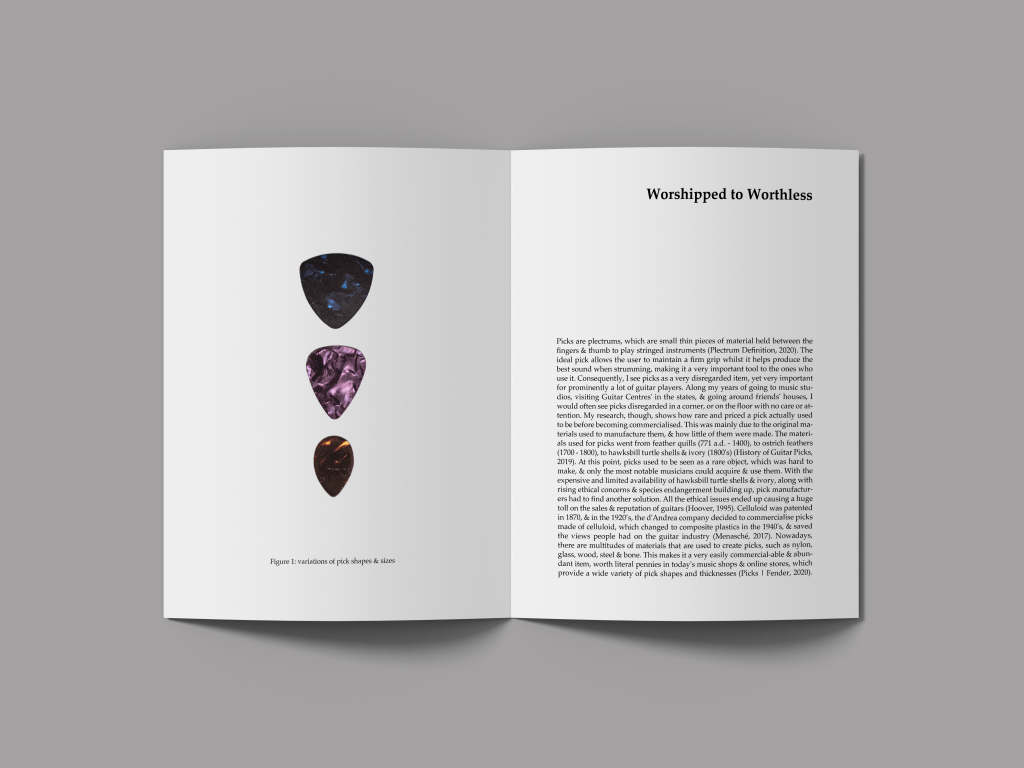
Reflection
I wanted my final outcome to look very clean & minimalistic. Picks are very clean & minimalistic themselves, so I thought it was well fit to on the left side have the picture of 3 different picks I own, & to balance out the entire design with the 300 word text on the right. I always make my text justified, I find it much neater & presentable than having it align left. I wanted my font to be simple & thin, but not too big so that it would not take over the image on the left. Finally, the title “Worshipped to Worthless” came about as I wanted to find an impactful title that would make the reader want to keep on reading (also alliteration), as I mention in the text that hundreds of years ago, picks were a very rare & prices object, while today they come cheaply & in abundance. In terms of research, I was very limited, I came across a book that helped with most of my research, the rest of my references are from websites.
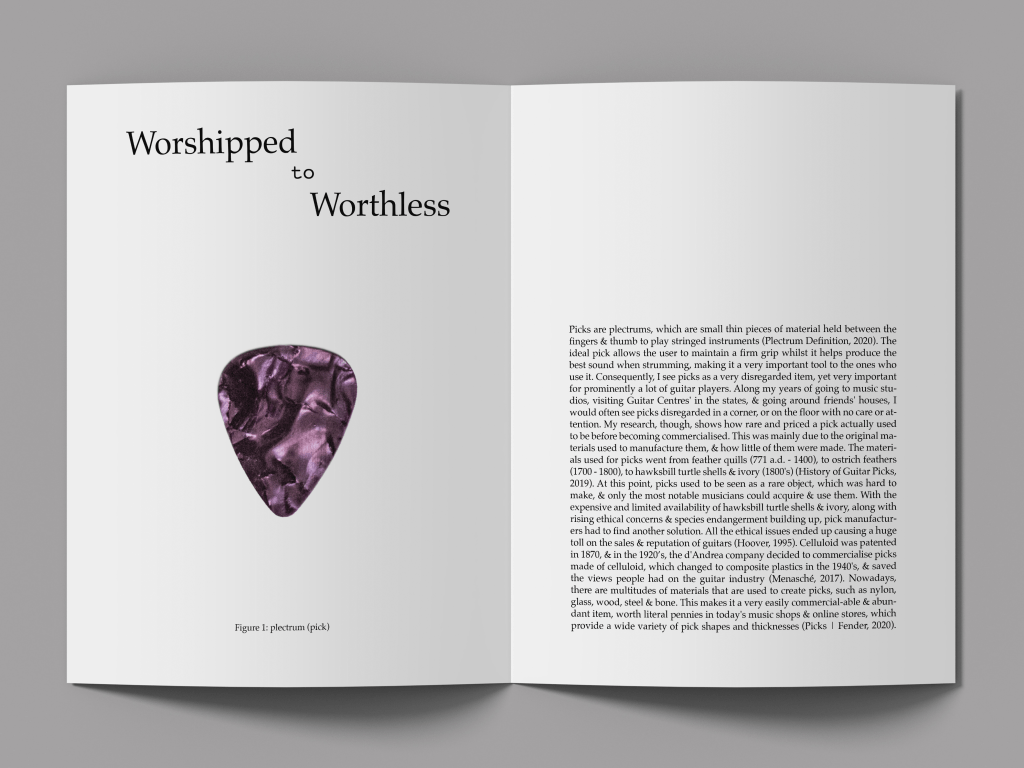
I chose to re arrange the design after getting feedback. The title was getting lost on the right hand side page, & having 3 picks was over crowding the layout. I also changed up the font so it would stand out more.
Final references:
Cambridge Dictionary. 2020. Plectrum Definition. [online] Available at: <https://dictionary.cambridge.org/dictionary/english/plectrum> [Accessed 11 March 2020].
Fender Shop. 2020. Picks | Fender. [online] Available at: <https://shop.fender.com/en-GB/accessoriespicks/> [Accessed 11 March 2020].
Hoover, Will. (1995). Picks!: The Colorful Saga of Vintage Celluloid Guitar Plectrums. Backbeat Books. [book]
Menasché, E., 2017. The (Surprisingly Long) History Of The Guitar Pick. [online] Premier Guitar. Available at: <https://www.premierguitar.com/articles/25204-the-surprisingly-long-history-of-the-guitar-pick> [Accessed 11 March 2020].
Sure Grip Guitar Picks. 2019. History Of Guitar Picks. [online] Available at: <https://www.suregripguitarpicks.com/post/history-of-guitar-picks-infographic> [Accessed 11 March 2020].
 Mandy Galli