LECTURE REFLECTION
Part 1: Symbolism and semiotics
I find the discussion of how messages are passed on in different cultured very fascinating. As an example, translating something word for word from a language to another, will give it an entirely different meaning, depending on the country, the culture & the past events associated with it. It is incredibly hard to pass a message, mainly in an advertisement setting, & catch the attention of an entire country. This is even harder when it is done in various countries. For instance, the way a company such as McDonalds advertises in France, is extremely different to how it does so in the Philippines. This is because the market had to be researched due to an entirely different culture, full of different habits, different media consumption, & most importantly, a different understanding of communicated messages.
Part 2: Case Study
The case study of the different Olympic logos designed for each country hosting the Olympics was really great to see. The deconstruction of each design & why they were made the way they were is very emblematic & unique to each country. The idea of going along with such a wildly globalised event, & allowing each nation to make it their own when it’s their turn to host the event is a great way to help communicate a countries’ values & cultures in a simple design.
Part 3: Patrick Thomas Breaking News 2.0
This installation really spoke to me. I like how there is no set rules to it & how messy it is. It really juxtaposes the way news are presented to us in a day where the internet is used more than anything, & how we are bombarded with thousands of headlines every day. It is an interesting concept, & mixing all the languages, phrasings, & news (whether it is something actually worth mentioning, something useful, something absolutely fake, or something random) really gives a nice insight on the world & our connectivity. It also shows that even though everyone communicates differently, it can all link together in a somewhat organised mess.
WORKSHOP CHALLENGE (final outcome)
What Lies Beneath?
Take a brand and look at how it is delivered in different countries. Is it symbolised in a different way? Why might colour or typeface have been changed? Does it work at a local level and does it work at a global level?
COCA-COLA

The classic Coca-Cola drink was developed by pharmacist John Pemberton, in 1886 in Atlanta. Originally, the drink was made with cocaine extracted from coca leaves, & caffeine extracts from the kola nut. The cocaine was later removed in 1903 (Coca-Cola Company, 2020). It was not long until the drink became a phenomenon, & that was partly due to great marketing. The company has great history of knowing how to target individual countries, & to this day, they sell their carbonated drinks in every single country apart from North Korea & Cuba (De Luce, 2019).
The companies’ first huge commercial was in 1971, when they created this commercial titled “Teach the World to Sing.” It showed people of different cultures & races coming together, looking towards a brighter future, & unifying them, making them feel apart of something on a global level.
Is it symbolised in a different way?
The company’s advertising looks different in each of the over 200 nations where it operates, but the ads are all still unmistakably for Coke.
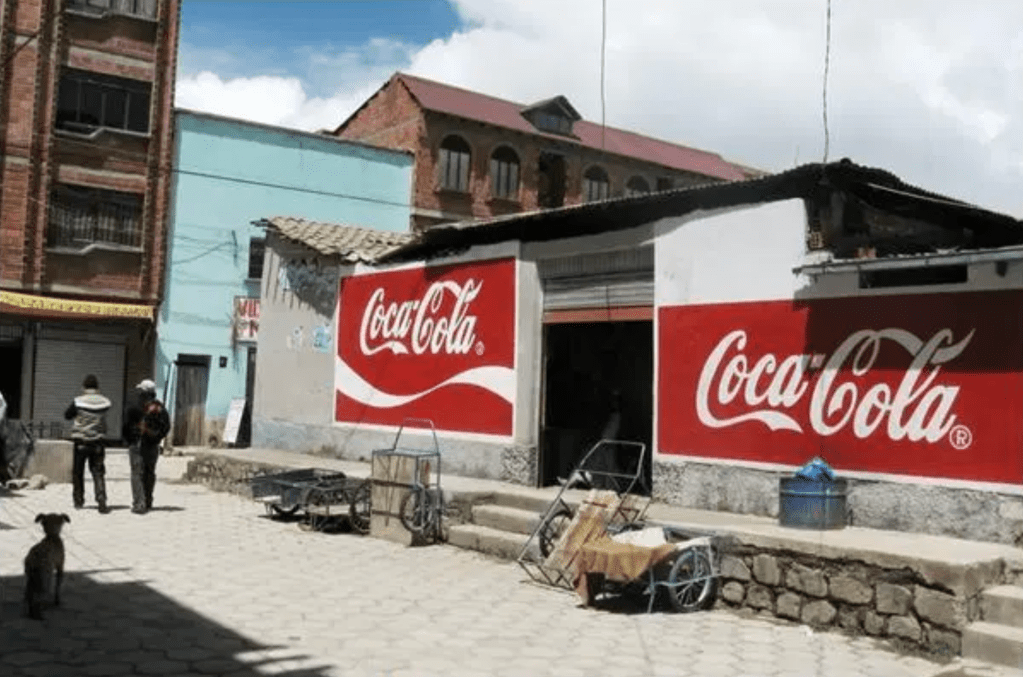
When looking @ advertisements of the brand in each country, we can see that they have adapted it to each country. For instance, in Nepal (pictured above). Being a developing country, it is easier to reach people via offline advertising. The most famous way of doing so it to paint doors/walls & shutters. The way it goes is the person who wants to put up the advert, needs to paint the entire house.
In China, the advertising is much more “in your face” with vending machines selling the drinks owned by the company all over the country. Today, China is Coca Cola’s 3rd largest market.
Even in countries like Argentina, Coca-Cola go as far as using traditional art styles to put through their branding.
Why might colour or typeface have been changed?
When looking @ their advertising around the planet, we can see their attention to cultural details. For example, the use of vending machines for detailed & elaborate branding in countries such as China (which then follows a similar pattern in Japan & South Korea).
The original type face of Coca-Cola is very rarely changed within nations. The only thing that changes is it may be translated into the language of the country it is in (for instance in China as pictured above). Coca-Cola is such a renowned brand that they don’t always need to translate their company name as it is such a huge part of most cultures that it is easily identifiable. They also keep their classic colours for the most part, which is red & white, & may add some elements of other cultures to make their brand almost blend in to the decor, like we can see in Argentina.
Does it work at a local level and does it work at a global level?
The biggest Coca-Cola market is with no surprise the United States. The branding in the country has caused the brand to become a renowned house hold brand, & the branding the company keeps putting out to keep the audiences engaged has shown to be very successful. Abroad, the brand is more powerful than ever. Just like the USA, Coca-Cola is a household brand for many other countries, from developing to developed, & in most cases is the most abundant & presented drink anywhere you go. As an example, when I lived in Thailand, we went out to do a really long trek in the rainforest. After hours of walking, we ended up in this very small restaurant-like place. Coca-Cola was advertised there, on plastified tarps, which were used as table cloths as well as roofs. When we went to the menu to order a drink, we found out that the only soft drink they had available was Coca-Cola, & what really surprised us, is that the price of a Coke bottle was half the price of a water bottle of the same size. This really shows the impact this brand has & will continue to have on the world.
REFERENCES
Coca-Cola Company, 2020. The Coca-Cola Company. [online] Available at: <https://www.britannica.com/topic/The-Coca-Cola-Company> [Accessed 21 April 2020].
De Luce, I., 2019. Coca-Cola Sold In All But 2 Countries On Earth. [online] Business Insider. Available at: <https://www.businessinsider.com/what-coca-cola-ads-look-like-around-the-world-2019-8> [Accessed 21 April 2020].
 Mandy Galli